Part of our guide to Denver excavation and underground drainage work.
The property owner usually fixes drainage problems caused by grading, downspouts, private drains, or soil conditions within the lot. If the water comes from shared property, a neighboring lot, a public right-of-way, or public infrastructure, responsibility depends on the source and the applicable property documents or jurisdiction.
The first step is not choosing a French drain or scheduling excavation. It is identifying where the water enters, where it collects, and where it can legally and reliably be discharged.
Start With the Source, Not the Wet Spot
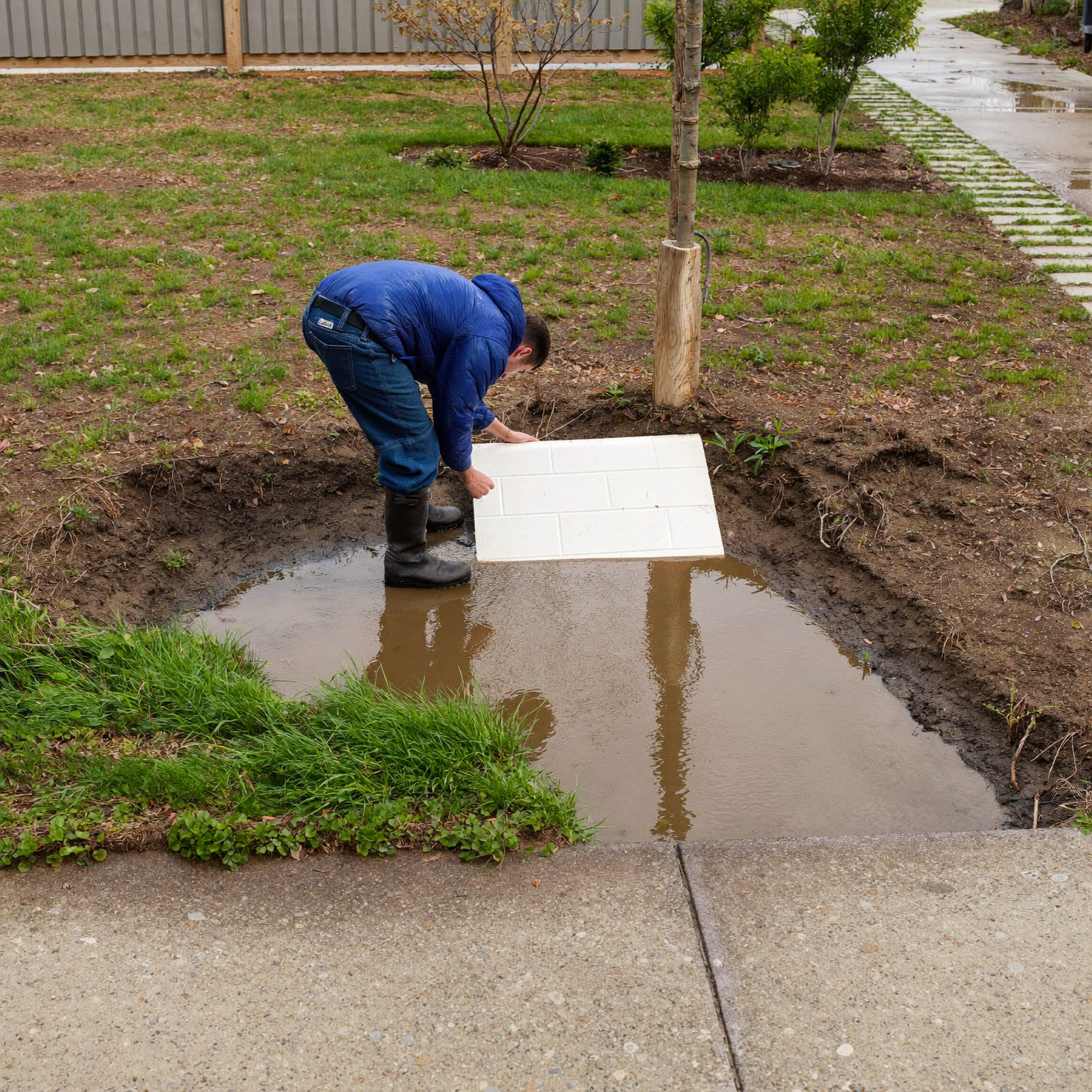
Standing water shows where drainage has failed, but it does not always reveal why. Water can travel across compacted soil, move below the surface through disturbed backfill, follow a foundation wall, or emerge downhill from the actual source. A low area in the lawn may simply be the final collection point.
In Arvada and surrounding Denver metro communities, drainage conditions can vary from one property to the next. Lot slope, landscaping changes, additions, patios, retaining walls, downspout extensions, irrigation, and buried utility trenches can all redirect water. Soil that absorbs water slowly can make a minor grading defect more visible, while highly compacted construction backfill can create an unexpected underground pathway.
Who May Be Responsible for the Repair?
Responsibility follows the failed feature more often than it follows the location of the visible water. A homeowner may have water in the yard because of a private grading issue, but the source could also be a shared roof drain, an HOA-maintained landscape, an uphill property, or infrastructure outside the lot.
The practical goal is to separate four possible categories: a private on-lot condition, a shared-property condition, runoff entering from another parcel, or a public-system concern. More than one category can apply. For example, runoff may enter from uphill while poor grading on the receiving property allows it to remain against the house.
Residents can also review service information for Arvada, Colorado. Drainage conditions and administrative requirements can differ in nearby communities such as Applewood, Colorado, even when the properties appear similar.
When a Private Drainage Contractor Is the Right Call
A private underground drainage contractor is appropriate when the likely solution involves buried piping, yard inlets, catch basins, controlled excavation, subsurface drainage, outlet correction, or reconstruction of a failed private drain. The contractor should first understand the water source and available outlet rather than treating the wettest spot in isolation.

Some drainage concerns can be addressed above ground. Extending a downspout to an appropriate discharge area, restoring a shallow swale, or correcting localized surface settlement may be enough. Other sites need a subsurface collection system or excavation to replace damaged pipe. The repair should match the mechanism causing the water to collect.
Why the Outlet Controls the Design
Every collection system needs somewhere for the water to go. Installing more pipe in a low yard does not solve the problem if the outlet is too high, blocked, prohibited, or positioned where the water returns to the property. The contractor must determine whether gravity drainage is possible and whether the discharge location is allowed.
A sound plan also avoids transferring the problem. Concentrating broad sheet flow into a pipe can increase the force of discharge at the outlet. Releasing that water near a sidewalk, neighboring lot, retaining wall, or foundation can create erosion, icing, settlement, or another drainage complaint.
How to Evaluate a Proposed Drainage Repair
A useful proposal should explain the observed source, the collection method, the route, the outlet, and the areas that will be disturbed. It should also identify assumptions that must be verified, such as pipe condition, easement restrictions, utility depth, or jurisdictional approval.
Be cautious when a recommendation is based only on seeing a puddle during dry weather. Also question a design that collects water without naming the discharge point. Drainage systems work as complete paths. Collection, conveyance, and discharge must function together.
The Practical Next Step
For an Arvada homeowner, the right first move is to record the water while it is active and determine whether the source is private, shared, neighboring, or public. Once the source and outlet are understood, the responsible party can select a repair that addresses the entire drainage path rather than moving the wet spot somewhere else.
If the problem involves private buried drainage, failed pipe, catch basins, or excavation, an underground line contractor can develop a site-specific repair plan. If ownership, an easement, or a public connection is uncertain, confirm those details with the HOA, property records, or the applicable jurisdiction before construction.